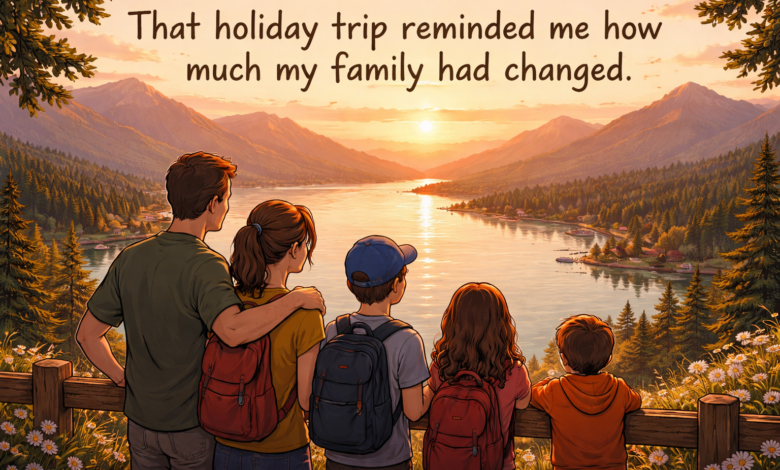
The holiday trip reminded me how much my family had changed long before I was ready to admit it.
The car was packed the way it always had been—suitcases stacked too high, the smell of oranges and coffee fighting for dominance—but the silence inside it was unfamiliar. My father drove with both hands tight on the wheel, my mother stared out the window as if the passing trees were telling her a story she didn’t want to hear, and my younger brother scrolled through his phone, detached from the ritual that once thrilled him. We were going back to my grandmother’s house for the first time in seven years, and no one said why.


As we crossed the old county line, memory crept in like fog. I remembered laughter echoing from the kitchen, my grandmother’s voice humming while she cooked, the way my family once felt unbreakable. But there was another memory too—one I had buried so deeply I’d convinced myself it wasn’t real.
The house looked smaller when we arrived. The porch light flickered, just as it had the night everything changed. Stepping inside felt like stepping into a paused moment, dust and time holding their breath. My grandmother had passed the previous winter, and with her death came a quiet insistence that we return, as if something unfinished had been waiting for us.
That night, while the rest of the house slept, I found myself standing outside the locked door of the back room. The room no one talked about. My chest tightened as the memory finally broke free.
I was sixteen again, standing in that same hallway, hearing raised voices. My father’s voice cracked as he confessed something I was never meant to hear: that he had planned to leave. Not just for a while—but for good. He had another life lined up, another future he thought would be easier than the one we were living. My grandmother had begged him to stay. She told him leaving would fracture us in ways he couldn’t fix. He stayed—but something broke anyway.
I had never told anyone I knew. I had grown up believing our distance, our careful conversations, were my fault somehow. That if I were easier, better, quieter, we would have gone back to the way we were.
The next morning, over breakfast, the truth spilled out of me like a confession. My voice shook as I told them what I remembered, what I had carried alone for years. The room fell silent. My father’s eyes filled with tears I had never seen before.
“I didn’t know you heard,” he said softly. “And I didn’t know how to fix what I broke.”
For the first time, we didn’t pretend everything was fine. We talked—about regret, about fear, about how love doesn’t always look the way it should. My mother admitted how hard it had been to trust again. My brother admitted he’d felt invisible growing up. And I realized the past hadn’t just shaped me—it had shaped all of us.
That holiday trip didn’t heal everything. But it did something just as important. It gave us the courage to face what we’d been running from.
When we left a few days later, the car felt different. Lighter. The road ahead still uncertain, but honest. I understood then that confronting the past doesn’t erase it—it frees you from letting it decide your future.
And for the first time in years, I wasn’t afraid of where we were going next.
Also Read: The Value Of Undivided Commitment